In the sprawling, resonating world of Wuthering Waves, few characters have left an imprint as deep as Cartethyia, the Blessed Maiden. Her journey from a mysterious story figure to a fully playable 5-star Resonator has been a defining arc for the game's narrative. Debuting prominently in the main storyline, Cartethyia — along with her regal, altered persona Fleurdelys — quickly became the subject of countless fan theories and emotional discussions. When her playable version was finally unleashed in version 2.4, it was not just her swirling Aero blades that drew praise, but also the exquisite voice work that breathed life into her dual identity. The voice acting, both in Japanese and English, turned out to be as multifaceted as the character herself, making Cartethyia one of the most memorable entries in Wuthering Waves' rapidly expanding roster.
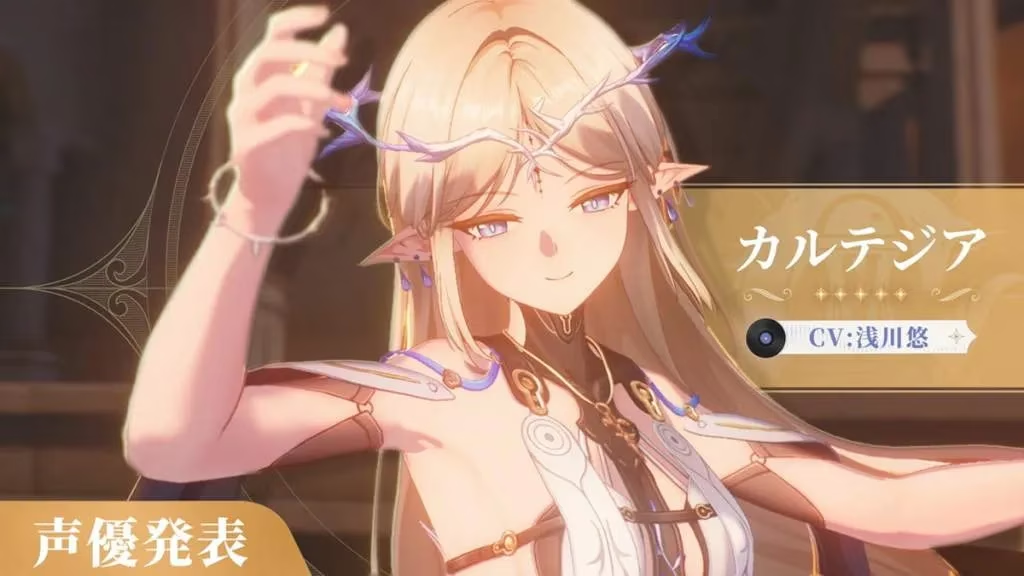
Stepping into the Japanese booth was none other than Asakawa Yuu, a veteran whose voice has shaped some of the most legendary figures in anime and gaming. Fans of the Fate franchise will instantly recognize her range — she has voiced not just one but five distinct Servants across the series: Stheno, Euryale, Ana, Medusa, and the Gorgon. Each character demanded a different shade of divinity, mischief, or sorrow, and Asakawa delivered them all with a signature silkiness that could turn razor-sharp in an instant. In Azur Lane, she gave voice to USS Ranger and ROC Yat Sen, two shipgirls with entirely different temperaments, while in Akame ga Kill, her portrayal of the elegant yet deadly Leone added layers of warmth and ferocity. Her roles extend even to the mythical realm of Granblue Fantasy, where she voiced both Anthuria and Predator, and to Vocaloid culture, where her recordings formed the basis for Megurine Luka's beloved vocal library. This breadth of experience made her the ideal choice for Cartethyia — a character who oscillates between a gentle maiden and a majestic, battle-hardened resonator. Asakawa captured both the fragility and the unyielding strength with an effortless flow, making the Japanese track a favorite among lore enthusiasts.
On the English side, the role fell to Amanda Rischel, a rising talent whose performance quickly silenced any doubts born from a comparatively shorter credits list. Prior to Wuthering Waves, Rischel had lent her voice to Lone in Carmen Curlers, Audrey in Strinova, and contributed additional voices to the monumental Diablo IV. While these roles might not carry the same immediate name recognition as a Fate heroine, they showcase a performer comfortable with everything from period-piece nuance to competitive-shooter attitude and dark fantasy ambiance. For Cartethyia, Rischel undertook the immense challenge of differentiating two starkly different sides of the same soul — the serene Blessed Maiden and the towering, armored Fleurdelys — and utterly succeeded. Her gentle, almost ethereal tone for Cartethyia in quiet moments contrasts sharply with the resonant, commanding timbre she adopts when the full power of the Resonator awakens. It's a showcase of vocal control that earned her a wave of new followers and solidified her place in the Wuthering Waves community. The casting direction clearly trusted her to carry one of the game's most emotionally complex characters, and that trust was rewarded with a performance that remains a benchmark for English dubbing in the gacha space.
Of course, a character's voice acting shines brightest when the gameplay gives it a proper stage, and Cartethyia does not disappoint. She arrives as a 5-star Aero-attribute Resonator who wields a Sword, immediately slotting into the upper echelons of power. Her design philosophy leans heavily into the Main DPS role, built around the unique Aero Erosion debuff mechanic. This effect, which chips away at enemies over time while lowering their resistance, adds a tactical layer to her flashy combos. Team builders have quickly discovered that she pairs seamlessly with characters like Ciaccona and Aero Rover, creating a synergy loop where Erosion stacks are constantly refreshed and amplified. When built correctly, her damage ceiling rivals that of Jinhsi — another story-critical, high-investment unit — and many theorycrafters consider her just as essential for clearing endgame content like the Tower of Adversity. The fluidity of her attack strings, combined with the graceful weight of her animations, makes every battle feel like a choreographed dance, a perfect vehicle for Rischel and Asakawa's vocal artistry.
Beyond the numbers and team compositions, Cartethyia's playable release was a moment of narrative catharsis. For months, players had navigated quests where the Blessed Maiden's fate seemed perpetually poised on a knife's edge. Her dual nature was not just a gameplay gimmick but a core thematic pillar — identity, sacrifice, and the coalescence of two souls into one weapon against the Lament. The voice actors understood this layering, and in nearly every cutscene, there are subtle tonal shifts that alert the attentive ear to who is truly speaking. It's the kind of detail that rewards replays and deepens the lore, turning a strong character into a truly unforgettable one.
Looking back from 2026, Cartethyia stands as a prime example of how Wuthering Waves blends compelling story-telling with polished action gameplay and top-tier voice direction. Both Asakawa Yuu and Amanda Rischel have become inextricable parts of her identity, and their performances continue to echo in fan edits, theory discussions, and the daily ritual of logging in to hear their Resonators speak. Whether you prefer the classic gravitas of the Japanese acting or the modern, textured delivery of the English cast, one truth remains: the Blessed Maiden never sounded better.