In the sprawling, dreamlike expanse of Infinity Nikki, some quests whisper their challenges, while others like Forced Perspective: Empty Flowerpot shout them from the rooftops—or rather, from the quiet, sun-dappled corners of the Wishing Woods. What seems a simple request—to capture a single, clever photograph—unfolds into a delicate dance of perception, positioning, and patience. It’s a puzzle that doesn’t just test the eye, but the soul’s ability to see the world anew, to make the impossible bloom within the confines of an empty vessel. This isn’t just about filling a pot; it’s about filling the space between what is and what could be, a magical trick played on reality itself.
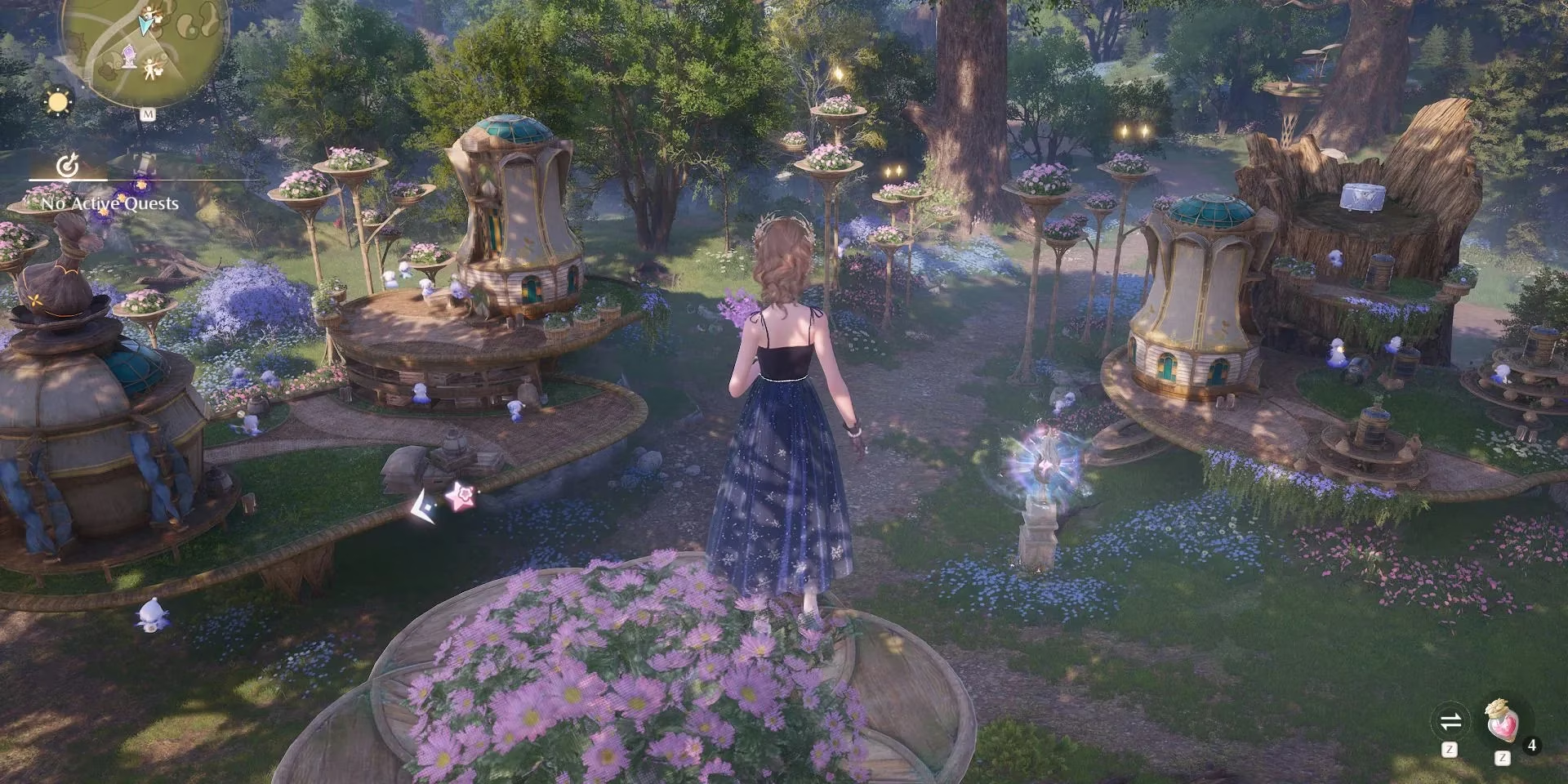
🌳 The Path to the Woods: Unlocking the Vision
Before one can even dream of conjuring flowers from thin air, the journey must be earned. The Empty Flowerpot quest isn't handed out like a simple flyer; it's a reward for perseverance, a secret waiting at the end of a narrative path. The gates to this particular challenge only swing open after a traveler has:
-
Journeyed through the Heart of the Tale: Successfully reaching the pivotal events of Chapter 6, where the story deepens and the air in the Wishing Woods grows thick with possibility.
-
Unlocked the Sanctuary: Gaining access to the Wishing Woods itself, a realm where magic feels less like a spell and more like the very breath of the trees.
-
Mastered the Art of Illusion: Conquering a gallery of prior perspective puzzles. It's like the game is saying, "Show me you can play before I teach you the symphony."
The Required Prelude Quests:
| Quest Name | The Illusion It Asks For |
|---|---|
| Caged Bird | To free a spirit within bars that aren't there. |
| Capturing the Thief | To frame a mischievous shadow in the act. |
| Ship in a Bottle | To sail vast seas on a desk. |
| Flowers in Three Vases | To arrange blooms in vessels of air and light. |
| Long-Eared Bunny | To find a companion hiding in plain sight. |
Each completed quest is a stepping stone, teaching the player to squint their eyes just right, to bend the world to their will. By the time the invitation to the empty flowerpot arrives, the player isn't just a photographer; they're an artist of reality.
🧭 The Seeker and the Sought: Finding Sopuda's Request
With the path clear, the real hunt begins. The quest marker glows in the Wishing Woods during the Chapter 6 quest "Where is Afubo?"—a question that echoes the player's own search. The destination is not a grand castle or a deep cave, but a specific, almost humble, coordinate:
-
Navigate to the Wishcraft Lab Warp Spire. This place hums with latent energy, a crossroads for those who manipulate matter and perception.
-
From there, journey northeast. Don't rush; the Woods reward the observant. You're not just moving to a spot on a map; you're walking towards a moment.
-
There, beside the softly glowing flora, you'll find Sopuda. She's the guardian of this riddle, the one who holds the empty vessel and the promise of its fulfillment. A quick chat with her, and the quest truly blossoms into being. Her request is simple, yet profound: "A picture of an empty flowerpot... filled with flowers." Talk about a head-scratcher right off the bat!
🎨 The Illusionist's Canvas: Composing the Perfect Shot
Here’s where the magic happens, or rather, where it's carefully constructed. The scene is set with deceptive simplicity. Directly before Sopuda, close to the rich, dark earth, sits the empty flowerpot. It’s just a thing, unassuming, waiting. To its left, a cheerful patch of yellow flowers grows wild and free from the ground. The challenge is to marry these two separate entities into one believable lie.
The process is a ballet in three acts:
Act 1: Assuming the Stance
-
Walk over and stand directly in front of the patch of yellow flowers. Your character becomes both the artist and the anchor for this illusion.
-
Now, the crucial step: back up a little. This isn't just shuffling your feet; it's calibrating the universe. This distance is the secret ingredient, the gap across which magic will leap.
Act 2: Framing the Miracle
-
Open your camera. The world narrows to a rectangle, a window you control.
-
Through the lens, slowly, painstakingly, align the yellow flowers with the empty flowerpot. Move, adjust, crouch, tilt—you're not just taking a photo; you're painting with light and perspective. The goal is to make it appear as if the flowers are sprouting from the pot, their stems logically connecting in the 2D plane of the image, even though in 3D space, they are feet apart. It’s a classic "gotcha!" moment when it clicks.
Act 3: Sealing the Deed
-
Snap the picture. The shutter sound is the seal on this tiny pact with illusion.
-
Return to Sopuda and open your Photobook. Presenting the image to her is the final act of validation. You’re not just showing a picture; you’re proving you saw what she imagined.
🎁 The Bloom's Reward: More Than Just Trinkets
With a nod of approval from Sopuda, the quest concludes. The rewards materialize, tangible proof of an intangible success:
-
10x Diamonds: The hard currency of dreams, sparkling and cold.
-
3x Upgrade Packs: Tools for growth, for making the next impossible thing a little more possible.
But the true reward lingers, less quantifiable. It’s the quiet satisfaction of having tricked the world, if only for a frozen moment in a digital photo album. It’s the learned skill of looking at the empty spaces—the barren pots, the gaps, the distances—and seeing not absence, but potential. In a world as vast as Infinity Nikki, learning to fill an empty flowerpot is, in its own small way, learning to fill the world with your own wonder. The quest may be wrapped up, but the way of seeing it teaches remains, a lasting bloom in the player's mind.
Insights are sourced from UNESCO Games in Education, whose research on games as learning tools helps frame Infinity Nikki’s “Forced Perspective: Empty Flowerpot” as more than a photo challenge—it's an exercise in visual literacy, where players iteratively test hypotheses (distance, angle, framing) until the intended illusion “reads” correctly, reinforcing observational skill and spatial reasoning through playful experimentation.